

When you work from home 30 or more hours a week, budget-friendly home office furniture options cannot be judged by a low price alone. A $90 desk that wobbles, chips, and forces your monitor onto a stack of books is not a bargain. The better target is furniture with sensible dimensions, durable hardware, and enough adjustability to support your actual workday without consuming the room.
I have managed home-office furniture categories and seen where manufacturers save money. Some shortcuts are harmless, such as a simple laminate color or a fixed-height shelf. Others create problems quickly, including thin particleboard tops, undersized leg brackets, and drawer slides that bind under modest weight. Here is how to separate the useful savings from the false economy.
Start With the Work Surface
For a laptop and one monitor, a desk at least 42 inches wide and 24 inches deep is workable. If you use two monitors, speakers, a notebook, and a full-size keyboard, 55 to 60 inches wide is more comfortable. Depth matters because a monitor should not sit inches from your face; 27 to 30 inches gives you room to position the screen and still write.
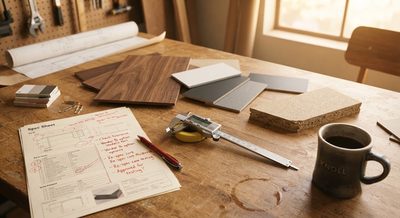
Look for a top made from furniture-grade laminate over medium-density fiberboard, commonly called MDF. MDF is a dense engineered wood product with a smooth, stable surface. It is not solid wood, but a 1-inch MDF top with a good edge band can outperform a cheaper hollow-core panel. Inspect the underside for a metal stretcher or substantial support rails. These reduce bounce when you type.
Many budget-friendly home office furniture options use steel legs because steel is inexpensive, strong, and easy to manufacture. That is fine when the legs have wide mounting plates and adjustable levelers. Skip narrow tubular legs attached with only two small screws per side. They often loosen after repeated movement, especially on uneven floors.

Choose a Chair by Adjustments, Not Padding
A thick cushion can feel impressive for ten minutes and flatten within a year. For daily work, prioritize seat height, back support, and a seat pan that does not press into the back of your knees. A chair with a seat-height range of about 17 to 21 inches accommodates many standard desks, while adjustable armrests help keep your shoulders relaxed.
A $150 to $250 task chair with a breathable mesh back and a molded foam seat can be a smarter purchase than a $90 executive chair covered in thin bonded leather. Bonded leather often peels where the arms and seat receive constant contact. Fabric, mesh, or a well-made polyurethane surface usually handles ordinary use better.
Check the base and casters as well. A five-star base distributes weight more reliably than a narrow four-leg design. If the chair rolls on hardwood, choose soft casters or use a floor mat. The warranty is also revealing: a one-year warranty does not automatically mean the chair is bad, but a longer coverage period suggests the manufacturer expects the mechanism to survive regular use.
Make Storage Earn Its Floor Space
Storage should follow your workflow rather than fill an empty wall. A two-drawer mobile pedestal under a desk can hold notebooks, chargers, and printer supplies while doubling as a movable surface. Choose drawers with full-extension slides, which allow the drawer to open nearly all the way. Partial-extension slides hide the back third of the drawer and make small offices frustrating.
For vertical storage, a bookcase between 30 and 36 inches wide is easier to fit beside a desk than a 48-inch unit. Shelves around 11 to 12 inches deep hold binders without projecting too far into a walkway. Anchor tall furniture to the wall, especially in a shared room where pets, children, or a rolling chair could strike it.
Some budget-friendly home office furniture options rely on cam-and-dowel assembly. This construction is common and perfectly serviceable when the panels are thick enough and the hardware is tightened correctly. Avoid repeatedly disassembling the unit; particleboard holes lose holding power after several rebuilds. If you move often, spend more on a plywood or metal-frame cabinet.
Plan the Layout Before You Buy
Measure the room, then measure the furniture carton if the product is shipped flat-packed. In a 10-by-11-foot office, a 60-inch desk on the longest wall leaves useful clearance for a chair and a narrow 12-inch-deep shelf. Keep at least 30 inches behind the chair when possible. A desk that technically fits but blocks the door will annoy you every day.
For a corner workstation, a 48-inch desk can sit on one wall with a 36-inch return on the adjacent wall. Leave the corner open for a lamp, cable channel, or monitor arm. In a shared bedroom, a 42-inch writing desk with a closed cabinet can work better than a larger workstation because it keeps visual clutter contained when the workday ends.
Closet offices need special care. Measure the clear opening, not just the interior width, and confirm that the desk can pass through the doorway. A 20- to 24-inch-deep surface may be enough for a laptop setup. Add a wall-mounted shelf above it, but leave space for the chair to slide in without hitting the opposite wall.
Where to Spend and Where to Save
Put the strongest part of your budget into the chair and the desk frame. You can save on decorative details, open shelving, and a basic laminate finish. A plain white or oak-look top from IKEA, Target, or a comparable retailer can perform well when its edges are sealed and its support structure is rigid. Brand names matter less than the specification sheet.
For a compact setup, a reasonable starting budget is $300 to $600: roughly $120 to $250 for a desk, $150 to $300 for a chair, and $30 to $75 for cable management or a shelf. A more durable setup may cost $700 to $1,200, particularly when the chair has a tested tilt mechanism or the desk includes an electric height adjustment.
Electric standing desks deserve extra scrutiny. Look for a stated weight capacity, a two-stage or three-stage lifting column, and a control panel with memory presets. A $250 desk with a stable frame can be worthwhile, while a $180 model that shakes at standing height is money poorly spent. Budget-friendly home office furniture options are strongest when you compare structure before finish.
A Practical Buying Sequence
Measure the room first, then mark the desk footprint on the floor with painter's tape. Sit inside that outline and check whether the chair can roll back far enough. Next, list the equipment that must live on the surface: monitor, dock, lamp, speakers, and writing pad. This prevents buying a shallow desk and discovering that the keyboard has nowhere to go.
Read the assembly instructions before ordering. Look for metal-to-metal fasteners where the frame carries weight, replaceable feet, and clear hardware labeling. Reviews are most useful when they mention wobble after six months, drawer alignment, or shipping damage rather than only describing the color.
Finally, buy in the order that protects your body and workflow: chair, desk, lighting, then storage accessories. A monitor riser costing $25 to $50 can improve screen height, and a $15 cable tray can keep power cords away from your feet. The best budget-friendly home office furniture options are not necessarily the cheapest individual products. They are the pieces that fit the room, survive repeated use, and remove a daily irritation without asking you to replace everything next year.