

The best budget home office furniture sets are not necessarily the cheapest matching desk, shelf, and cabinet bundles. A useful setup needs the right working height, enough depth for your monitor and keyboard, storage that does not wobble, and materials that can handle eight hours of daily use. I have managed home-office furniture categories and built my own desk three times, so I look at these packages as systems rather than decorative room fillers.
For most remote workers, a practical budget is $300 to $700 for a desk, basic storage, and a functional chair purchased separately. Sets priced below $250 can work in a corner or temporary apartment, but compromises usually show up in thin particleboard, small work surfaces, weak drawer slides, or a chair that becomes uncomfortable before lunch. The smart purchase is the one that puts money into the parts you touch and load every day.
What a budget furniture set should include
Start with the desk. A full-time workstation should generally be at least 48 inches wide and 24 inches deep. If you use two monitors, 55 to 60 inches wide gives you better clearance for speakers, a notebook, and a lamp. A 30-inch desk depth looks generous in a product photo but often leaves little room once a monitor stand and keyboard are installed.
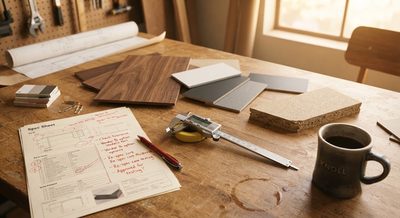
Look for a laminate or melamine work surface over a reasonably thick engineered-wood panel. These materials are not automatically inferior to solid wood. A well-sealed 1-inch panel with a steel frame can outperform inexpensive pine that twists as humidity changes. The frame should use bolted or welded connections rather than thin cam-lock fittings alone. Cam locks are the circular fasteners used in many flat-pack products; they are convenient, but they need solid board material around them.
Storage should match your workflow. One file drawer is useful for tax documents, while an open shelf handles books and a printer. Avoid sets with a tall bookcase that is narrower than 24 inches unless the room is extremely tight. Narrow shelves are easy to overload and tend to sway when loaded with binders.

The best layout for small rooms and shared spaces
A 10-by-11-foot spare bedroom can comfortably hold a 60-by-30-inch desk, a 24-inch-wide drawer unit, and a 30-inch-deep chair clearance behind the desk. Put the desk on the longest wall if possible. That leaves a walking path of roughly 36 inches and keeps the chair from colliding with a bed or closet door.
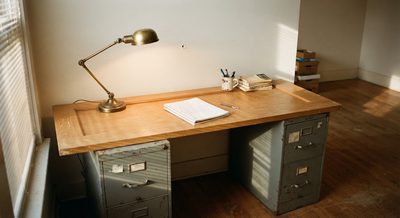
For a corner workstation, use an L-shaped set only when both walls offer at least 48 inches of usable length. Many inexpensive corner desks have a deep center corner that becomes dead space. A straight 55-inch desk paired with a rolling three-drawer unit is usually easier to assemble, move, and reconfigure.
Shared spaces need a different approach. A 42- to 48-inch desk can fit against a living-room wall, especially with a monitor arm and a chair that tucks fully underneath. Choose storage with doors or drawers if video calls happen near the workstation. Open cubbies quickly become visual noise, particularly when they hold cables, notebooks, and shipping supplies.
The best budget home office furniture sets for small spaces prioritize footprint over matching pieces. You can buy a desk from one line and add a narrower cabinet from another if the heights and finishes are close enough. Function matters more than a perfect catalog match.
Where cheap construction causes trouble
The first failure point is usually the desktop edge. A paper-thin edge band, which is the plastic or veneer strip covering the panel edge, can peel when a chair arm or vacuum hits it. Look for a rounded, heat-sealed edge or a solid edge strip. Run a finger along the underside as well; rough fiberboard there is a sign that the surface is not well protected from spills.
The second issue is drawer hardware. Basic metal roller slides are acceptable for light stationery, but they can feel rough under a loaded file drawer. Full-extension ball-bearing slides let the drawer open farther and typically feel more stable. That feature is worth paying an extra $30 to $60 for if you store documents or camera equipment.
The third issue is wobble. A desk can be stable on a showroom floor and shake at home if one leg sits on uneven flooring. Adjustable levelers help, but a rear stretcher, the horizontal support connecting the legs, does more to control side-to-side movement. Standing desks need especially rigid frames because raising the work surface increases leverage.
Matching the chair, monitor, and cable plan
A furniture set cannot fix an unsuitable chair. Keep at least $150 to $300 of the total budget for a chair with adjustable seat height, a padded seat pan, and back support that reaches the middle of your shoulders. A $400 desk with a $60 chair is a poor trade for someone working full time. Brands such as HON, Branch, and Staples house brands offer several practical options, but fit matters more than the logo.
Your desk should allow your elbows to rest near 90 degrees while your feet stay flat. If the desk is too high, a footrest is cheaper than replacing the entire workstation. A monitor should sit with the top of the screen near eye level, so reserve $25 to $80 for a monitor stand or arm. Check that the desktop can accept a clamp before ordering an arm; some hollow-core tops cannot support one safely.
Plan cables before assembly. A rear cable tray, adhesive clips, and a six-outlet surge protector can cost less than $40 and prevent the usual tangle. Leave two inches between the desk and wall if the plugs point straight backward. Sets with built-in wire grommets are convenient, but one small grommet is not enough for a laptop, monitor, lamp, speakers, and charger.

Materials and brands worth comparing
IKEA remains strong for modular planning because lines such as MICKE and TROTTEN offer common widths and replacement-friendly parts. The tradeoff is that some lightweight panels and basic hardware are better suited to moderate use than heavy daily loads. Sauder and Bush Furniture often provide more traditional desks and storage at roughly $150 to $500 per piece, with designs that fit bedrooms and multipurpose rooms.
Wayfair has the widest range, but its marketplace model means specifications and quality can vary considerably between sellers. Read the actual dimensions, panel thickness, weight rating, and warranty instead of relying on staged photographs. Amazon Basics can be sensible for simple desks and monitor stands, while FlexiSpot is worth comparing for lower-priced electric standing desks; verify frame capacity and return terms before buying.
The best budget home office furniture sets often come from mixing these categories rather than purchasing one branded bundle. Buy the strongest desk you can afford, then add a basic shelf and a separate drawer unit. Matching color is easier than correcting a sagging desktop.
A five-minute buying checklist
Measure the room, doorways, baseboards, and the space behind the chair before ordering. Confirm the assembled dimensions, not just the shipping-box size. Check the desktop depth, frame material, drawer slide type, shelf weight rating, and whether a replacement part policy exists. If the desk weighs only 30 pounds at a claimed 60-inch width, expect more movement than a 70-pound model with a rear support.
Read recent reviews for assembly problems rather than finish complaints. Repeated reports of missing bolts, misaligned predrilled holes, or stripped inserts point to quality-control issues. A two-year limited warranty is more useful than a vague “lifetime” promise that excludes hardware and normal wear.
Finally, add the hidden costs: delivery, assembly, a chair, cable management, and a monitor stand. A $299 bundle can become $500 after those additions, while a $379 desk with better structure may produce a more durable result. Compare complete setups, not sticker prices.
The sensible purchase
For a full-time remote worker, I would choose a 55- to 60-inch desk with a 24- to 30-inch depth, one stable drawer unit, and a separate chair. For a bedroom corner, I would choose a 48-inch desk, wall-mounted shelving, and a compact task chair. For a temporary rental, a simple laminate top with steel legs is usually smarter than ornate storage that cannot move easily.
That is the useful definition of best budget home office furniture sets: a coordinated workstation that supports your body, equipment, and daily routine without spending on details that do not improve either. Measure first, inspect the construction, and spend the extra dollars on stability, chair fit, and cable control. The result will look less like a showroom package and work much better as an office.