
Ten Years in Furniture Told Me One Thing
I walked into my first supplier meeting in 2014 carrying a notebook full of sketches I thought were brilliant. By the time I walked out, a factory owner in Dongguan had politely explained why three of my five ideas would literally fall apart after six months of daily use. That was the day I stopped being a designer on paper and started understanding furniture as something that gets bolted together, shipped across an ocean, sat on, leaned on, and knocked into with a vacuum cleaner every Tuesday.
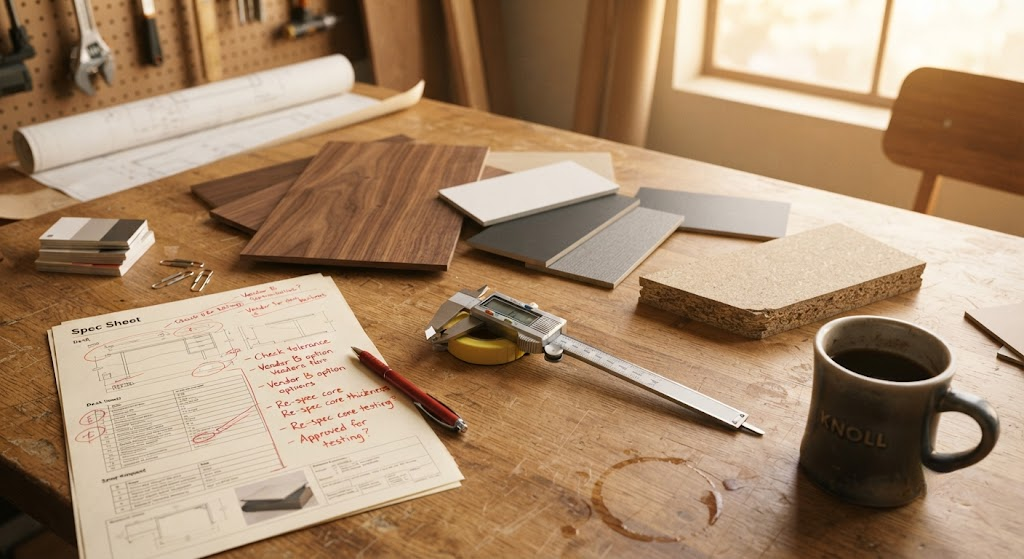
I spent the next decade as a product manager overseeing home-office and storage categories for a major Southeastern furniture brand. I visited factories in Vietnam, China, and North Carolina. I sat through hundreds of supplier meetings, argued about $0.03 cost differences on laminate grades, and killed more bad desk designs than most people have ever seen in a showroom. And over all those years, I kept noticing the same gap: the online advice about home offices was either pure eye candy — brass desk lamps and fiddle-leaf figs — or absolute DIY purism that assumed everyone owned a table saw and three spare weekends.
Nobody was explaining the middle ground. The place where real budgets, real room dimensions, and real eight-hour workdays collide with furniture that has to hold up.
What You'll Get Here (That You Won't Find Anywhere Else)
This blog is that middle ground. I'm going to talk about desks the way a product manager thinks about them — not as a piece of scenery, but as an engineered surface you interact with for forty hours a week. Every recommendation you'll read here is grounded in something specific: a dimension, a material spec, a warranty clause, a factory-floor observation, or a lesson I learned the hard way by building or buying something that didn't work.
Three Commitments I'm Making Right Now
1. Every number earns its place.
I won't tell you a desk is "spacious." I'll tell you it's 60 inches wide, and that with two 24-inch monitors on arms you'll have exactly 12 inches of open surface in the middle. You'll see room plans drawn to real footprints — 10×11, not "a cozy nook." I'll call out the walkway you forgot to leave behind your chair because I've designed enough rooms to know that 36 inches is the minimum, not a suggestion.
2. The cheaper option gets a fair hearing.
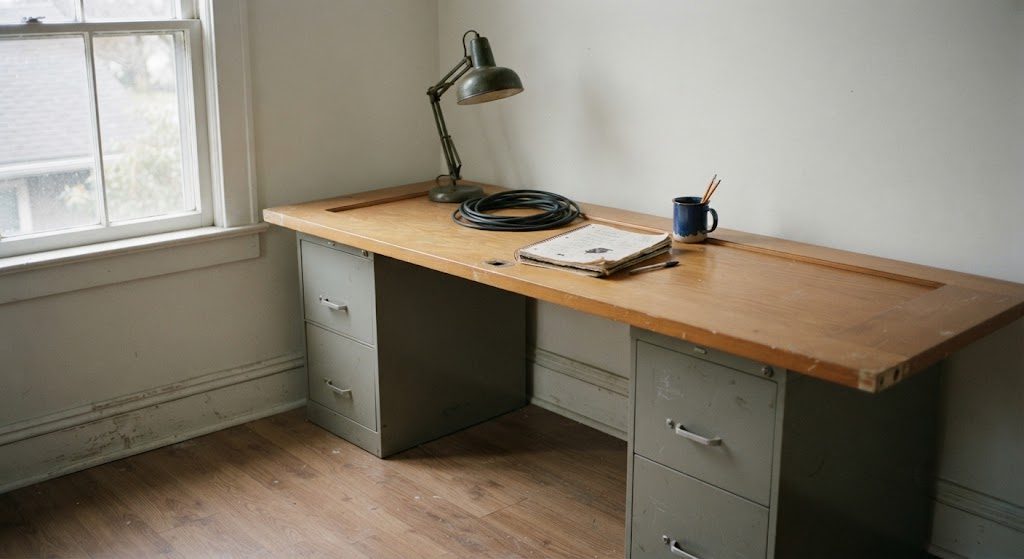
In my years as a PM, I learned that expensive doesn't always mean better. Sometimes a $50 standing desk converter does 90% of what a $2,500 electric frame does. Sometimes a hollow-core door on two filing cabinets — my first real desk — teaches you more about workspace than any showroom piece. I'll never talk you into an upgrade unless the difference in materials or engineering actually justifies the price gap.
3. I'll show you the ugly parts.
Factory visits, failed prototypes, the time I spec'd a bookshelf and forgot about baseboard clearance — these stories are here because they're where the actual knowledge lives. Every product I review is something I've either personally tested for a full work week or walked the factory floor where it was made. No exceptions.
The Post That Started This
I bought my first "real" desk at 24. It was particle board with a woodgrain laminate so thin I could peel it with a fingernail. It wobbled on carpet, had no cable management, and the monitor shelf put my screen at exactly forehead height. I suffered through it for two years because I didn't know what I didn't know.
That desk became the reason I care about this stuff. This blog is what I wish someone had handed me a decade ago: a field guide for people whose office has to work, because their livelihood depends on it.