

A home office setup desk is not just a surface for a laptop. It is the central piece of a work system, and its depth, height, construction, and cable management determine whether you finish the day comfortable or folded over like a lawn chair. After years managing home-office furniture products, I start with the room and workflow before looking at finishes or brand names.
The useful question is simple: what must happen at this desk every day? A software developer with two 27-inch monitors needs a different footprint from a consultant who travels with one laptop. A good plan leaves room for the equipment you use now, plus a little breathing space for the task you will add next year.
Start with dimensions, not the catalog photo
For most remote workers, 48 inches wide is the practical minimum. It fits a laptop, monitor, keyboard, and a writing area without forcing the mouse onto a stack of mail. Sixty inches is a better target for two screens, speakers, or paperwork. Go to 72 inches if the desk must support video equipment, a printer, or two people sharing the surface.
Depth matters just as much. A 20-inch desk looks efficient online but leaves little room to position a monitor safely. I prefer 26 to 30 inches for a seated workstation. That allows the screen to sit about an arm's length away while keeping the keyboard near the front edge. If you use a monitor arm, confirm that the rear clamp has clearance and that the back edge is not a thick molded panel.
Standard desk height is roughly 29 to 30 inches, but that range is not automatically right for you. With your shoulders relaxed, your elbows should rest near a 90-degree angle while your forearms are level. A height-adjustable frame is useful when two people share the workstation, although a fixed desk with the correct height is often sturdier and less expensive.

Choose materials that earn their space
The desktop material affects durability more than the finish color. Solid wood can be repaired and refinished, but wide boards move slightly with seasonal humidity. In Charlotte, where moisture changes are noticeable, a solid wood top needs a stable base and properly designed attachment points. Screwing it tightly to a metal frame at every location can create stress and splitting.
A quality veneer top uses a thin real-wood layer over a stable core, usually medium-density fiberboard or particleboard. Medium-density fiberboard is smooth and consistent, while particleboard keeps prices lower but depends heavily on edge protection and hardware. Look for a top at least 1 inch thick, sealed edges, and threaded inserts rather than screws driven directly into the board.
Laminate is the practical underdog. A well-made high-pressure laminate top resists coffee rings, scratches, and ordinary office abuse, and it can cost substantially less than walnut or oak. The important detail is the core and edge banding. If the edge lifts after a year, the attractive surface has not delivered much value.
The frame deserves the same inspection. A steel leg assembly should not rock when you push the desk from the side. Test the adjustment controls on a sit-stand model and listen for grinding or uneven movement. A two-stage lifting column is adequate for many home offices; a heavier three-stage column gives more range but is not automatically worth the premium.
Design the setup around your actual room
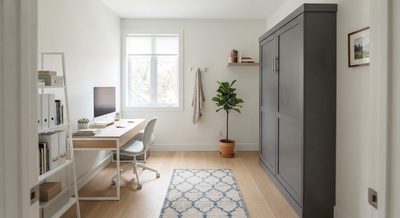
A 10-by-11-foot spare bedroom can hold a 60-inch desk on one wall, a 36-inch-deep storage cabinet on the opposite wall, and a clear walkway between them. Keep at least 30 inches behind the chair so you can stand and move without bumping into furniture. If the room also serves as a guest room, a 48-inch desk on a short wall leaves more floor area for a sleeper sofa or folding bed.
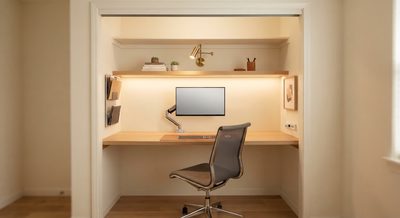
For a living-room corner, measure both walls and the chair's pulled-out position. A corner desk can waste space if its diagonal return blocks a doorway. Two straight pieces, such as a 48-inch desktop meeting a 36-inch return, often create a cleaner work zone. In a closet office, check depth before buying anything: a 24-inch desk may leave no room for knees once trim and doors are counted.
Shared spaces need visual discipline. Use a desk with a modest cable tray, a monitor riser, and a narrow drawer unit that can roll away. IKEA tabletops and separate legs can be a sensible low-cost solution, but inspect the span. A 60-inch top without a center support may sag under heavy monitors and books.

Spend money where your hands and eyes notice it
A strong budget for a complete workstation is often $500 to $1,500 before a computer. The desk may consume $250 to $800, with the remainder going toward a chair, monitor arm, lighting, and cable hardware. Spending $900 on a beautiful desk while using a $90 chair is usually backwards. The chair and monitor position affect your body for every working hour.
If you have $600, put approximately $250 into a stable 48- or 60-inch desk, $250 into an adjustable chair with a usable seat-depth range, and the balance into a monitor arm and task light. If you have $1,200, improve the desktop and chair before adding decorative shelving. Brands such as Herman Miller, Steelcase, Vari, Fully, and IKEA occupy different price and construction tiers, so compare specifications rather than logos.
A premium purchase should bring something measurable: a longer warranty, quieter lifting motors, better cable access, replaceable parts, or a top that can be refinished. A $1,000 desk with ordinary particleboard, weak cam locks, and a one-year warranty is not a premium desk simply because the product photography is polished.
Fix cables, lighting, and monitor height together
Cable management should be planned before the desk reaches the room. A rear cable tray keeps power bricks off the floor, while a vertical sleeve gathers cords down one leg. Leave enough slack for the desk to rise if it is adjustable. I also recommend labeling both ends of each important cable before routing it; five minutes now can save an hour under the desk later.
Place the monitor so the top third of the screen sits near eye level. A monitor arm frees surface space, but clamp pressure can damage a soft desktop, so use a reinforcement plate when needed. For lighting, put a task lamp to the side opposite your writing hand or use diffuse overhead light behind the screen. Bright light directly behind the monitor creates glare and makes your eyes work harder.
The final check is reach. Your daily notebook, headset, and phone should be available without leaning forward. Items used once a week can live in a drawer or shelf. A home office setup desk works best when the surface supports active work rather than becoming permanent storage.
A buying checklist before you order
Measure the wall, doorway, elevator, and route into the room. Confirm the assembled width, depth, height range, and shipping weight rather than relying on a rounded listing title. Ask whether the desktop arrives attached, whether replacement hardware is available, and whether the warranty covers the frame, motor, and surface separately.
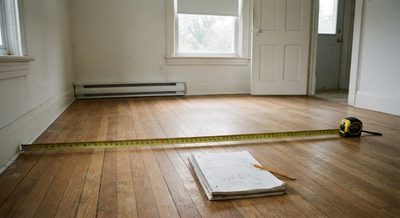
Then test the workflow with painter's tape on the floor. Mark the desk outline, chair clearance, filing cabinet, and door swing. Sit inside that outline with your elbows at desk height. This cheap rehearsal catches the common mistake of buying a desk that fits the wall but not the person.
Finally, decide what you are willing to repair. If you want a desk for ten years, prioritize replaceable feet, accessible fasteners, a refinishable top, and a company that publishes parts. If you expect to move within two years, a lighter laminate desk with knockdown construction may be the smarter buy. The best home office setup desk is the one that matches your room, workload, and willingness to maintain it.