
The Desk That Started Everything
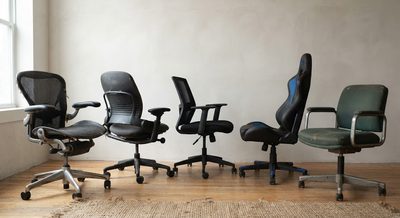
I was 23, fresh out of NC State's industrial design program, working my first real job at a furniture company, and I had no desk at home. Not a bad desk — no desk at all. I'd been using a kitchen table that belonged to my landlord, and the chair was a dining chair with a curved seat that tilted my pelvis forward after an hour.
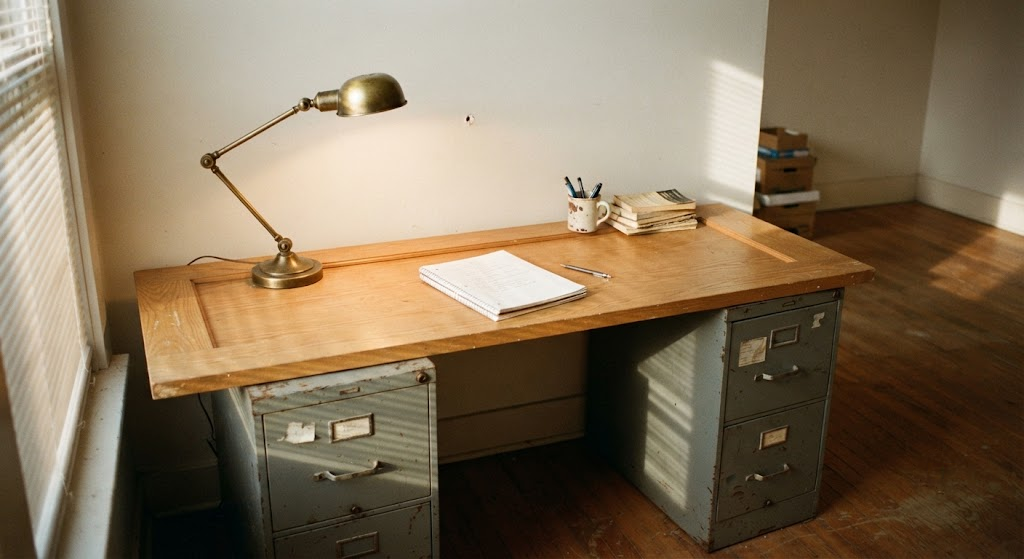
A colleague in the engineering department mentioned that the local Habitat for Humanity ReStore sold hollow-core doors for $10. Filing cabinets showed up there regularly for $15 apiece. The math was immediate and unavoidable: for under $50, I could build a desk with more surface area than anything in our company's mid-range catalog.
So I did. And that desk — that $47 door on two mismatched filing cabinets — became my primary workspace for the next two years. I wrote product briefs on it. I took video calls before anyone cared about backgrounds. I spilled coffee on it, sanded it, painted it, and eventually gave it away to another broke new hire when I moved.
I've since worked on desks that cost more than my first car. None of them taught me as much.
Lesson 1: Surface Area Is Not a Luxury — It's a Workflow Requirement
The hollow-core door I bought was 80 inches long and 30 inches deep. That's bigger than most "executive" desks on the market today. In those 2,400 square inches, I could spread out a laptop, a second monitor I'd salvaged from IT, a notebook, a cup of coffee, a stack of material samples, and still have room to rest my forearms.
Why Most Desks Feel Cramped
The industry standard for a home-office desk is 48 inches wide by 24 inches deep. That's 1,152 square inches — less than half of what that door gave me. A 48-inch desk fits a single monitor and a keyboard. Add a notebook and a phone, and you're nudging things out of the way. Add a second monitor, and you're stacking.
The door taught me that generous surface area isn't about showing off. It's about eliminating the micro-decisions — where does this go, can I set this here, do I need to move the lamp — that interrupt your focus across an eight-hour day. When I later became a PM and spec'd desk sizes, I pushed hard for 60-inch and 72-inch options in the product line. The 48-inch desk isn't inherently bad, but it's not a default; it's a compromise you should make knowingly, not by accident.
Lesson 2: Stability Comes from Weight Distribution, Not Weight Alone
The door weighed maybe 20 pounds. Each filing cabinet, fully loaded with papers, weighed close to 80. The door sat on top with nothing but gravity and a strip of rubber shelf liner holding it in place. The whole setup should have been wobbly.
It wasn't. The cabinets were wide and low — each one had a footprint of roughly 15 by 24 inches. The door's weight pressed straight down through their frames into the floor. There was no lateral wobble because the load path was purely vertical. The lesson I internalized: a desk's stability isn't about how heavy the legs are; it's about the geometry of the base and whether the load transfers cleanly.
Years later, when I evaluated standing-desk frames for a product line, I tested for side-to-side deflection at standing height by pushing laterally with a calibrated force gauge. Frames with narrow feet and tall columns failed early. Frames with wide, cross-braced feet — the same principle as those filing cabinets — held steady. The door taught me that before I had the vocabulary to articulate it.

Lesson 3: Cheap Materials Force Honest Decisions
A hollow-core door is not furniture-grade material. It's a thin veneer skin over a cardboard honeycomb. When you drill into it, the bit punches through the skin and spins in empty space. You can't clamp to it. You can't screw monitor arms into it without a reinforcement plate. Every modification requires a workaround.
That constraint was clarifying. I couldn't accumulate gear because the desk wouldn't support it. I had to choose what actually belonged on the surface and what could live on the floor or in a drawer. The door enforced a minimalism I would never have chosen on my own, and that minimalism kept me productive.
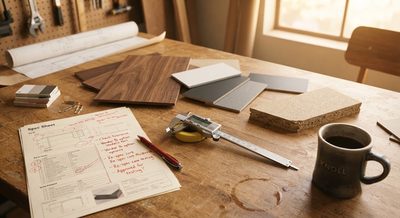
When I later worked on a premium standing desk with a solid walnut top, I found myself with the opposite problem: so much surface, so much capacity, that I slowly filled it with things I didn't need. A second monitor became a third. A desktop speaker system appeared. A charging dock. A headphone stand. The desk could handle all of it, but my focus couldn't. The door's lesson — constraint as a design principle — is something I still return to when my workspace starts feeling cluttered.
What That Desk Means to This Blog
Every recommendation I make on The Desk File traces back to those two years with a door on cabinets. Not because I think everyone should build a desk for $47, but because the principles that desk taught me — generous surface area, clean load paths, and material honesty — apply to every desk at every price point.
If you're reading this and you're still working on a kitchen table, know that your first real desk doesn't need to cost a month's rent. It just needs to be big enough, stable enough, and honest about what it can and can't do. Everything else is negotiable.