
The Show Floor Tells the Truth
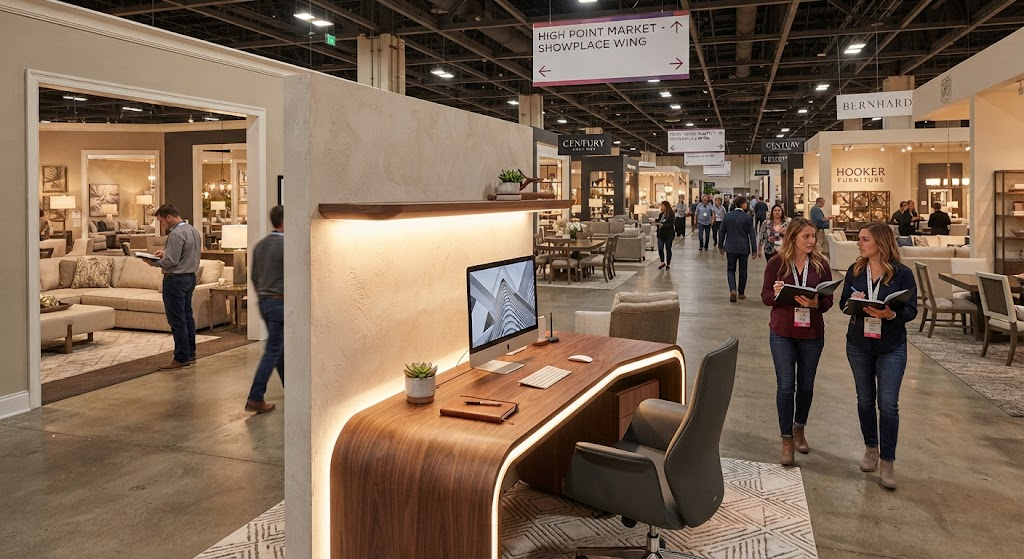
I've walked High Point Market every spring and fall for ten years. The showrooms change — new finishes, new brands, new buzzwords — but one thing stays consistent: you can tell which trends have real traction by watching what buyers actually write in their order books, not what gets photographed for Instagram.
This season, three trends stood out. Not the headline-grabbers. The ones with purchase orders behind them.
Trend 1: The Curved Desktop Is Back — But Functional This Time
Curved desks have been around for decades, but this season's versions are different. The curve isn't a decorative flourish — it's a functional response to multi-monitor workflows.
What I Saw
Several mid-to-premium brands showed desks with a concave front edge — the curve cuts inward, bringing the user deeper into the workspace. The radius is typically 60 to 80 inches, wide enough to cradle dual monitors without forcing the user to swivel their chair.
Why It's Winning
A flat-front desk with dual monitors forces you to turn your head roughly 30 degrees to see the edge of each screen. A concave desk pulls both monitors into a natural arc that matches your neck's range of motion. Buyers are ordering these for professional home offices where users spend eight-plus hours in front of screens. The manufacturers I spoke with confirmed this category is up 40% in pre-orders compared to last season.
PM's note: If you buy a curved desk, check the depth at the center. A 24-inch-deep desk with a 6-inch inward curve leaves you with only 18 inches at the deepest point — too shallow for a keyboard and a notebook. Look for a 30-inch overall depth minimum.
Trend 2: Integrated Power and Lighting Are Moving Inside the Desk
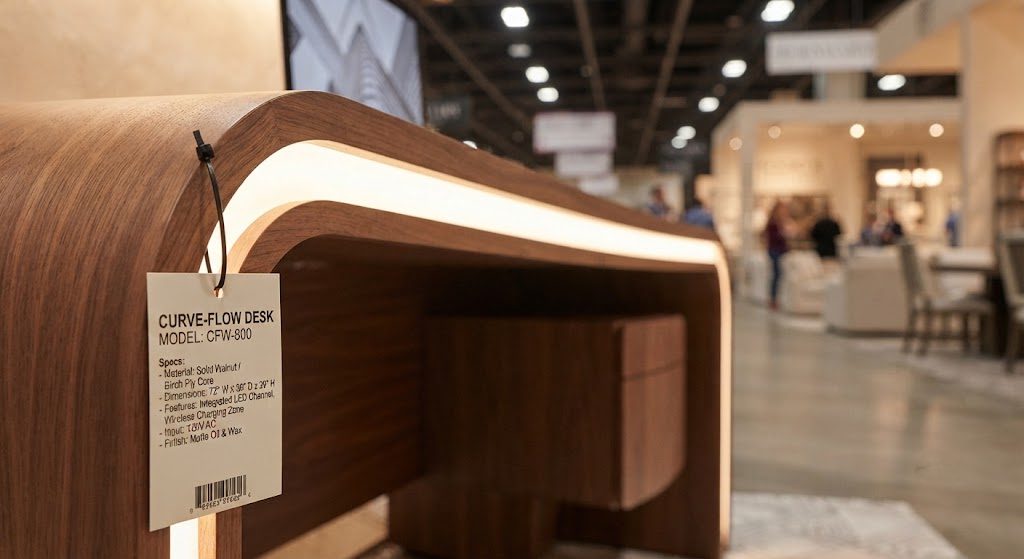
Grommet-mounted power modules have been standard for years. What's new this season is power and lighting built into the desk structure itself — not added on, but designed in from the start.
What I Saw
Three brands showed desks with LED task lighting embedded in the front edge, shining downward onto the user's lap area for video calls. Two others had Qi charging pads laminated directly under the desktop surface, invisible until you place your phone on a marked zone. One premium manufacturer debuted a sit-stand desk with a battery backup integrated into the frame — enough to raise and lower the desk twice during a power outage.
Why It's Winning
The home-office user is now also a video-call studio operator. Front-edge lighting solves the "overhead shadow" problem without adding a ring light to the desk surface. Invisible charging eliminates a cable. These aren't gimmicks — they solve real daily friction points. Buyers at the mid-to-high end are treating integrated tech as a differentiator, and at least two brands told me these SKUs are outselling their non-integrated equivalents two to one.
PM's note: Integrated electronics mean integrated failure points. Ask about warranty on the electrical components specifically. A five-year frame warranty often doesn't cover the LED strip or the charging module. Get that in writing.
Trend 3: Desking Systems Are Replacing Single Desks
The most significant shift I observed wasn't a product — it was a category. Buyers are moving away from individual desks and toward desking systems: coordinated L-shaped configurations, desk-and-return combinations, and wall-mounted systems with matching storage.
What I Saw
Several brands that previously sold desks as standalone units now offer "home-office systems" — a main work surface, a return for meetings or secondary tasks, and a matching storage credenza or hutch, all designed to be ordered from a single SKU family. The finishes match across all pieces. The desk height and return height are coordinated. Cable routing is designed to connect between pieces.
Why It's Winning
Remote workers are investing in their offices as permanent spaces, not temporary setups. A system costs more upfront — typically $1,500 to $4,000 — but solves the problem of the mismatched desk, the filing cabinet that doesn't align, and the bookshelf that's a different wood tone entirely. Buyers told me the return rate on system orders is lower than on individual desks because the customer commits to the whole room at once, gets it right, and doesn't try to piecemeal it later.
PM's note: If you're considering a system, check one thing: Are the connecting brackets included, or are they a separate SKU? I saw one system where the connector kit added $120 to the order, and it wasn't listed anywhere on the showroom signage. That's the kind of detail that shows up on the invoice and erodes trust.
What I'm Watching Next
One trend I'm not yet convinced by: AI-integrated desks that adjust height based on "usage patterns." I tested one prototype on the floor, and it raised mid-conversation because the sensor interpreted my gesturing as "standing up." Early days. I'll revisit it next season. For now, the three trends above — curved desktops, integrated tech, and system thinking — are the ones with real orders behind them. If you're buying in the next year, expect to see these features move from the show floor to the product pages.