
You're Here Because the Kitchen Table Isn't Working
Maybe your back hurts. Maybe your laptop is surrounded by breakfast dishes. Maybe you've bought a desk before — one that wobbled, or didn't fit, or looked great for three months and then the laminate started peeling. Whatever brought you here, you're ready to build something real: a home office that supports eight hours of focused work, five days a week, for years.
I spent ten years as a product manager for home-office furniture. I've seen what works and what fails. This guide pulls together everything on The Desk File into a single step-by-step process. If you read nothing else, read this.
Step One: Measure Your Room (The Right Way)
Before you look at a single product, measure your space. Not just length and width — the full inventory of your room's constraints.
What to measure:
Floor dimensions at both floor level and desk height (walls aren't always straight)
Ceiling height in three spots — use the lowest number
Every wall projection: radiators, window sills, baseboard heaters, return-air grilles
The door swing arc — furniture within that arc will be hit every time the door opens
Window position relative to where your monitor will sit
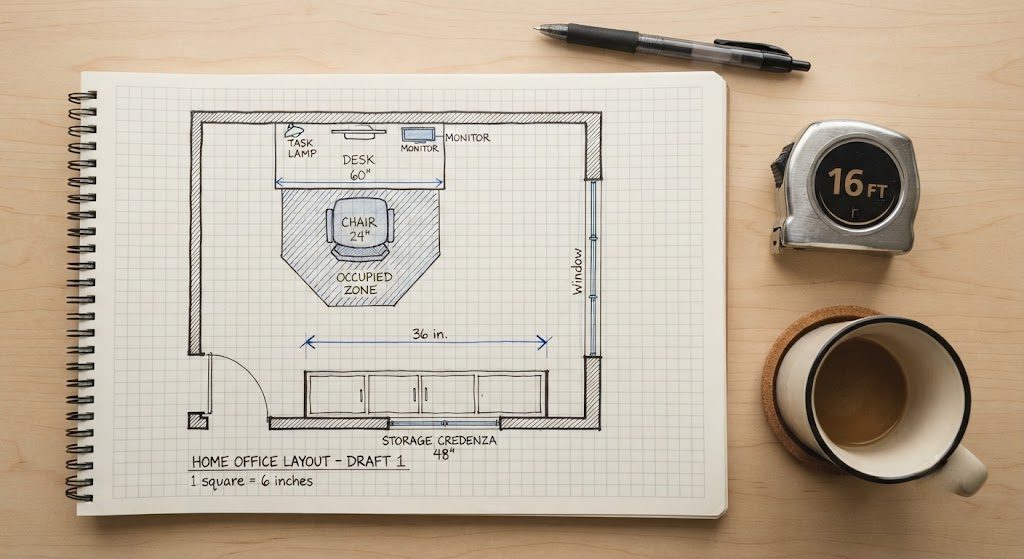
The walkway rule: Leave 36 inches minimum between your occupied desk chair and the wall or furniture behind you. This single dimension prevents more furniture returns than any other. In a 10-foot-deep room, that means: room depth (120 inches) minus desk depth (24 inches) minus occupied chair depth (30 inches) minus walkway (36 inches) leaves only 30 inches for storage on the opposite wall. Do this math early.
Take photos of the room with dimensions taped to the walls. You'll reference them constantly.
Step Two: Pick Your Desk Type
The desk is the foundation. Every other decision flows from it. You need to choose three things:
Surface size: For a single monitor, 60 inches wide by 30 inches deep is the sweet spot. For dual monitors, go 72 inches wide. Don't buy a 48-inch desk unless your room physically cannot fit wider — it'll feel cramped within a month.
Height adjustability: This isn't about standing versus sitting. It's about fitting the desk to your body. A fixed 29-inch desk works for the 50th percentile. If you're shorter than 5'6" or taller than 6'1", a fixed-height desk will force you into poor posture. A sit-stand frame lets you dial in your exact elbow height.
Material: Laminate handles abuse and moisture. Solid wood is refinishable but demands care. Veneer looks warm but can't be repaired if scratched through. For most first-time buyers, high-pressure laminate (HPL) on an MDF core hits the best balance of durability and price. Avoid melamine — it's the thin, cheap laminate that peels within two years.
Step Three: Budget Your Spend — The 60/20/20 Rule
Most first-time buyers overspend on the desk and underspend on everything else. Here's a product-manager's budget framework:
60% to the desk and chair combined. Split roughly 35% desk, 25% chair. The chair matters as much as the desk — your spine logs the same hours your laptop does.
20% to storage. Shelving, a filing cabinet, or a credenza. Buy only what you need for the items you actually own, not what looks good in catalog photos.
20% to lighting, cable management, and accessories. A good task lamp, a cable tray, and a monitor arm will improve your daily experience more than a more expensive desk surface.
This breaks down to roughly: $600–$900 for a quality sit-stand desk, $400–$600 for a chair that won't hurt you, $300–$400 for storage, and $300–$400 for everything else. You can build a fully functional office for $1,600–$2,300 total. You can also spend far less by buying used or building yourself. The 60/20/20 ratio holds regardless of your total budget.
Step Four: Place Your Lighting Before You Place Your Decor
Lighting determines whether your eyes are exhausted by 3 PM. Three sources, minimum:
Ambient: A ceiling fixture or floor lamp that lights the whole room. Warm white, 3000K–3500K.
Task: A desk lamp with an adjustable arm, positioned to the side of your monitor — never in front, where it'll reflect off the screen.
Bias: A small light behind your monitor, shining onto the wall. This reduces the contrast between a bright screen and a dark wall, which is the primary cause of screen-related eye strain.
If your room has a window, position your monitor perpendicular to it. Monitor facing the window creates glare. Window directly behind the monitor creates silhouetting. Perpendicular gives you natural light without the penalty.
Step Five: Plan Your Cable Management Before You Build
The time to think about cables is before your desk is assembled and covered in equipment. The one solution that handles 80% of desks: an under-desk cable tray, mounted toward the back edge, holding the power strip and all excess cable slack. The only cord that should touch the floor is the power strip's connection to the wall outlet. Everything else lives in the tray.
If you're buying a desk, check whether it has an integrated tray or at least pre-drilled mounting points for one. If you're building, add the tray during assembly — it's ten minutes of work that prevents years of tangled cables.
Step Six: Buy Once, Not Twice
The most expensive desk is the one you replace after eighteen months. I've watched too many people buy a $200 desk, hate it, buy a $500 desk, outgrow it, and finally buy the $900 desk they should have bought first. Total cost: $1,600 and two years of frustration.
Buy the right size the first time. Buy the material that matches your abuse profile — laminate if you're hard on surfaces, solid wood if you're willing to maintain it. Buy a chair you've sat in for at least twenty minutes, not one you've read about. And measure the walkway.