
The Chair Is the Hardest Thing to Buy
Desks are straightforward — measure, choose a material, bolt it together. Chairs are personal in a way desks never will be. Your spine has opinions it hasn't shared with you yet, and a chair you loved for ten minutes in a showroom can become unbearable by Wednesday afternoon.
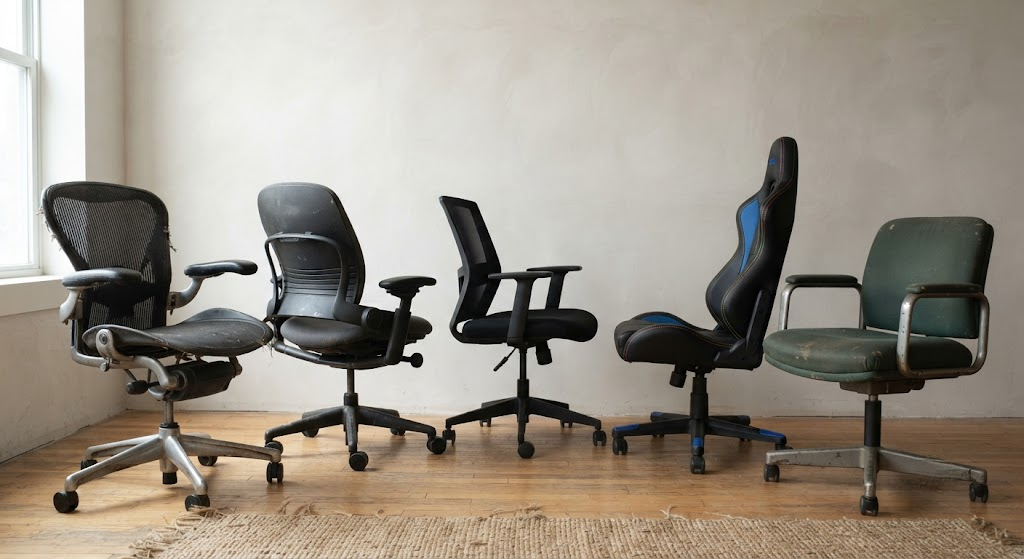
Over the past eight years, I've done full work weeks in dozens of chairs. These five are the ones I kept long enough to form real opinions about. None of this is sponsored. One of these chairs is still under my desk right now. One of them I gave away after two weeks.
Chair 1: Herman Miller Aeron (Remastered, Size B)
Spec sheet says: Pellicle mesh suspension, PostureFit SL lumbar, 12-year warranty. The industry benchmark.
What it doesn't say: The Aeron punishes bad posture immediately and rewards good posture permanently. The mesh seat pan has a rigid front edge — if you sit with your legs crossed or one foot tucked under you, that edge will dig into your thigh within thirty minutes. This isn't a design flaw. It's a behavioral intervention. The chair is telling you to sit correctly, and it's not polite about it.
After forty hours, my lower back felt better than it had in years. The PostureFit SL system supports the sacrum, not just the lumbar curve, which is the difference most chairs miss. But the mesh seat means you can't shift positions casually — you sit the Aeron way or you're uncomfortable. For focused work, that discipline is an asset. For a full day that includes casual reading, phone scrolling, and leaning back to think, the rigidity becomes tiresome.
The armrests are fully adjustable but feel flimsy side-to-side compared to the rest of the chair's build quality. After a year, mine developed a slight wobble. Functional, but annoying at this price.
Who it's for: Someone who sits in one position for long stretches and wants active posture correction. Not for cross-legged sitters or people who shift constantly.
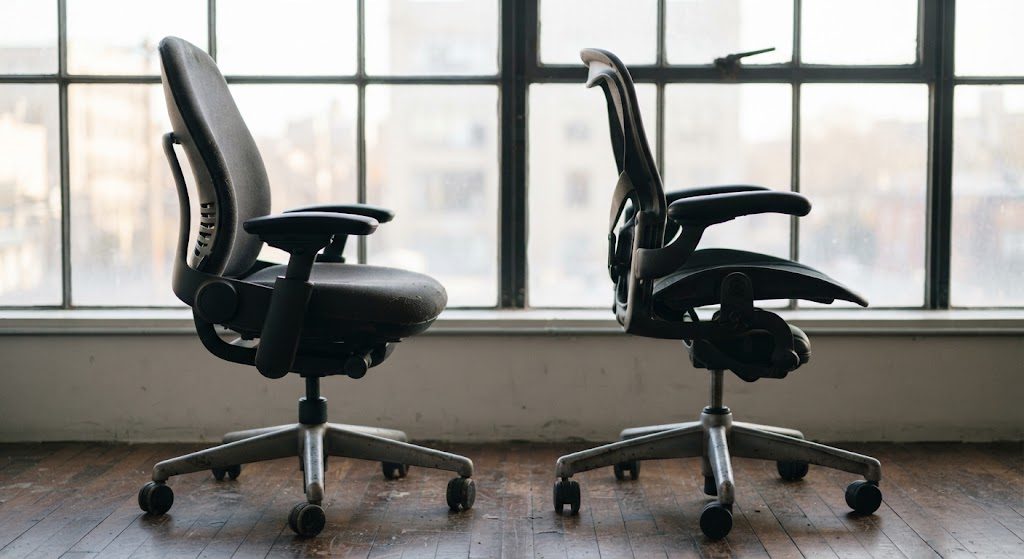
Chair 2: Steelcase Leap V2
Spec sheet says: LiveBack flexing backrest, natural glide recline, adjustable seat depth. The ergonomist's choice.
What it doesn't say: The Leap is more forgiving than the Aeron but just as supportive. The backrest flexes with your spine as you move — you can lean sideways to grab something off a shelf and the chair follows the motion instead of fighting it. This flexibility means you forget you're sitting in an ergonomic chair, which is the highest compliment I can give.
The seat cushion is foam, not mesh, and it holds up. My Leap is four years old, and the cushion hasn't compressed or developed a soft spot. The seat depth adjustment is a sliding mechanism that actually stays where you set it — a small thing that fails on cheaper chairs within months.
The weakness is the lumbar adjustment. It's a simple tension knob that increases or decreases the firmness of a plastic insert. It works, but it's imprecise — there's no height adjustment, so the lumbar support hits wherever your spine happens to align with the chair back. For me, at 5'11", it's perfect. For someone shorter or taller, it might press into the wrong vertebrae.
Who it's for: Someone who moves around while working — leaning, reaching, shifting. If you want support you don't have to think about, this is the best chair I've tested.
Chair 3: Secretlab Titan Evo (2022)
Spec sheet says: Cold-cure foam, magnetic head pillow, 4D armrests, built-in lumbar adjustment. The gamer's choice that claims to be an office chair.
What it doesn't say: This chair is comfortable for exactly two hours. Then the foam starts to feel firm in a way that isn't supportive — it's just hard. The cold-cure foam is dense, which is good for durability but bad for pressure distribution. By hour four, I was shifting my weight constantly. By day three, my lower back ached in a way I hadn't felt since my hollow-core-door desk days.
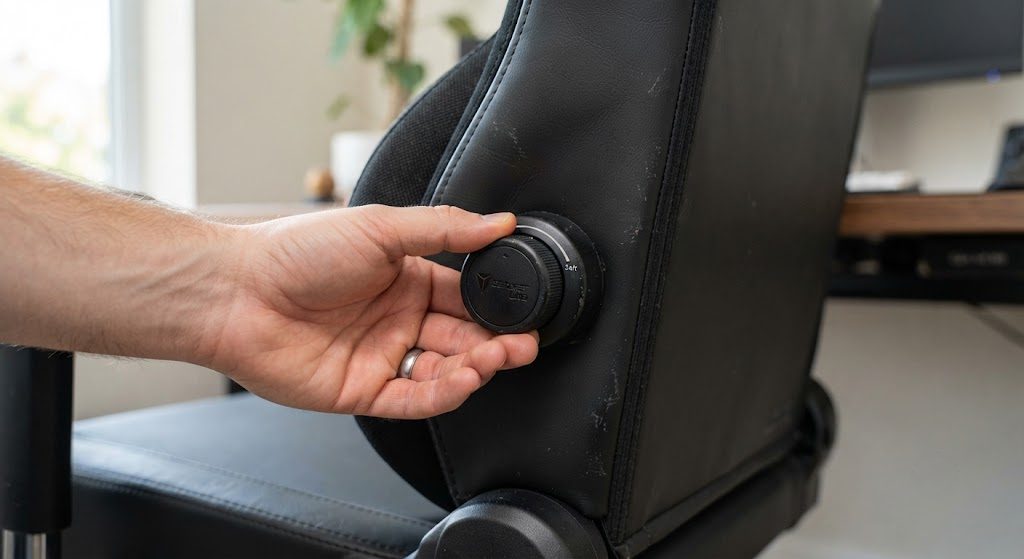
The lumbar support is a dial on the side that adjusts an internal mechanism. It's effective at creating a curve, but the curve is aggressive and narrow. It feels like a fist pressing into one spot on your spine. The Aeron and Leap distribute support across a wider area. The Titan concentrates it. Some people like that; I found it fatiguing.
The magnetic head pillow is clever but unnecessary for upright work. It's designed for reclined gaming, not for typing at a desk. The armrests are the best part of this chair — truly adjustable in four directions, with a soft-touch top that doesn't wear through. I wish I could put these armrests on the Leap.
Who it's for: Someone who reclines more than they sit upright — gamers, video editors who lean back during renders. Not for eight hours of focused upright work.
Chair 4: Branch Ergonomic Chair
Spec sheet says: Mesh back, foam seat, adjustable lumbar, 7-year warranty. The budget-friendly ergonomic option at roughly $350.
What it doesn't say: This is the chair that surprised me. I bought it for a secondary workspace expecting mediocrity and got a chair that does 80% of what the Leap does at one-third the price. The mesh back is tensioned well — not Aeron-level taut, but breathable and supportive through a full workday. The foam seat is medium-firm and hasn't packed down after eighteen months of intermittent use.
The lumbar support is a simple sliding plastic bar behind the mesh. It adjusts up and down but not in and out. At its highest setting, it hits my lumbar curve correctly. At its lowest, it's essentially absent. The range works for most body types, but there's no fine-tuning — it's either in the right spot or it isn't.
The armrests are the weak point. They adjust up and down and pivot slightly, but they don't slide forward or back. If your desk is deeper than 24 inches, you'll find yourself reaching forward off the armrests to type. After a few hours, that reach translates to shoulder tension. This is the compromise that separates the Branch from the Leap — the armrests don't move with you.
Who it's for: Someone who wants real ergonomics under $400 and doesn't rely heavily on armrests while typing. A strong value proposition for a secondary or starter chair.
Chair 5: Refurbished Steelcase Criterion (1990s Era)
Spec sheet says: Nothing. This chair predates online spec sheets. Steel frame, foam cushions, adjustable arms and seat depth. A Craigslist find I paid $80 for.
What it doesn't say: This chair is heavy. It weighs roughly 60 pounds. The steel frame was built before manufacturers optimized for shipping weight, and it feels like furniture, not a product. The foam is thick — three inches of high-resilience polyurethane that hasn't degraded in three decades. The recline mechanism is a simple spring tension knob that still works perfectly.
I bought this chair out of curiosity and kept it because it taught me something: the basics haven't changed. Good foam, a steel frame, adjustable seat depth, and armrests that lock in place are all you actually need. Everything else is refinement.
The Criterion lacks the postural sophistication of the Leap or the Aeron. It won't correct your spine. But it doesn't cause problems either, and for $80 plus a set of replacement casters, it's the best value in seating I've ever encountered. The used office-furniture market is flooded with these old Steelcase and Herman Miller tanks. If you're near a major city, find a liquidator and sit in a few. You might spend $100 and get a chair that outlasts everything else in this list.
My Personal Ranking
After forty-plus hours in each, here's where I land:
Steelcase Leap — The chair under my desk right now. Support I don't notice, which is exactly what I want.
Herman Miller Aeron — Brilliant but demanding. I'd use it if I had a dedicated focus room.
Branch Ergonomic — The smart budget choice. Gets the important things right.
Refurbished Steelcase Criterion — The value wildcard. Find one in good condition, buy it, stop thinking about chairs.
Secretlab Titan — Not a work chair. Comfortable for lounging, punishing for typing.