
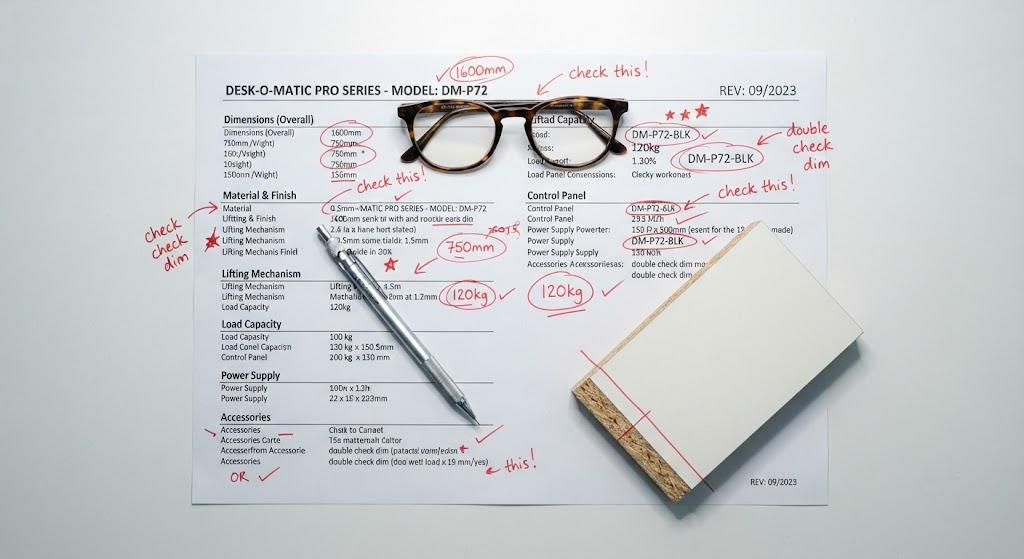

The Spec Sheet Is a Contract, Not a Brochure
In my product-management years, I wrote, revised, or rejected hundreds of spec sheets. To a PM, a spec sheet is a legally binding list of promises. To a customer, it’s usually skimmed for the desktop photo and the price. If you change nothing else about your shopping process, start reading the spec sheet as if the furniture brand will be held to every number — because in a warranty claim, they will be.
You don’t need an engineering degree. You just need to know which four sections separate a five-year desk from a two-year disposable.
1. The Core Materials: What’s Inside That Surface
The “Material” field usually says something like “Engineered Wood” or “Solid Wood + Veneer.” Here’s the product-manager translator:
Particle Board
Compressed wood chips and resin. Lightweight, inexpensive, and surprisingly consistent in flatness. It fails under moisture — a spilled drink left overnight will swell the edge permanently. If the spec says “particle board” without a moisture-resistant claim, do not put it in a room with humidity swings.
MDF (Medium-Density Fiberboard)
Finer wood fibers, more resin, denser. Holds screws better than particle board and machines cleanly for cable cutouts. Heavier, though, and still vulnerable to water unless sealed. A desk made of MDF with a high-pressure laminate surface is one of the best value propositions in the market.
Plywood
Layers of cross-grained wood veneer glued under pressure. Strong, lightweight, and screw-holding. Furniture-grade Baltic birch plywood rivals solid wood in durability at half the cost. If a spec sheet says “plywood” without specifying grade, assume it’s commodity construction ply, which can have internal voids.
Solid Wood
Rubberwood, acacia, oak, walnut. Repairable, refinishable, beautiful. It expands and contracts with humidity — a solid wood top on a metal frame must have elongated screw holes to allow for movement. If the spec sheet doesn’t mention that allowance, expect warping.
2. Weight Capacity: The Number That Separates Reality from Marketing
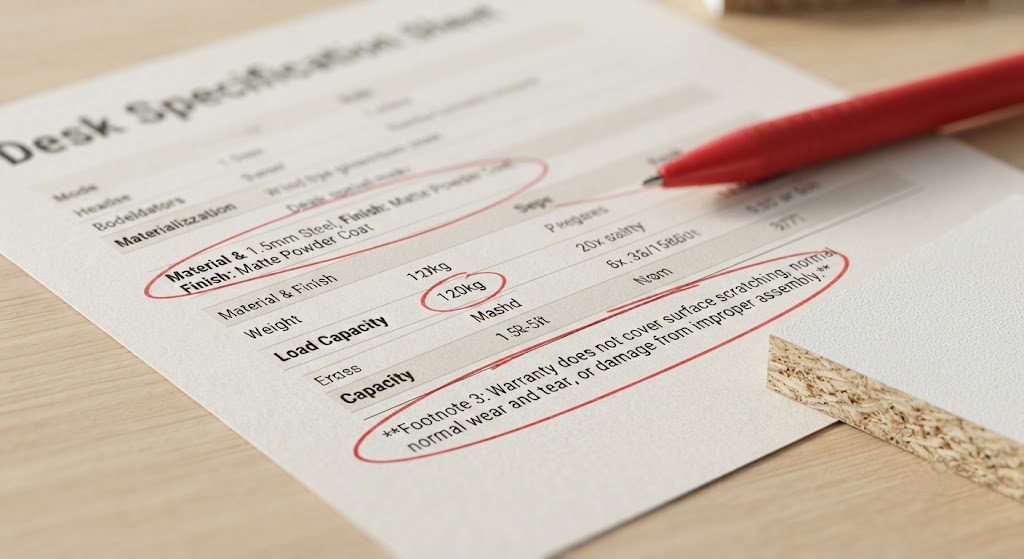
“Holds up to 150 pounds” means nothing without context. Is that static or dynamic capacity? A desk holding 150 pounds of monitors can fail at 60 pounds if the load shifts during raising and lowering. Look for “dynamic capacity” — the weight the frame can handle while moving. If the manufacturer only lists static capacity, assume the dynamic rating is lower by 30–40%, and keep your equipment well under that threshold.
3. Laminate Grade: The Scratch-and-Moisture Code
Laminates range from melamine (a single layer of printed paper fused with resin) to high-pressure laminate (HPL, multiple kraft paper layers under extreme pressure). Melamine scratches and chips at edges within a year of daily use. HPL resists both and can take a hot coffee mug directly. If the spec sheet just says “laminate” without specifying type, it’s almost certainly melamine. Walk away if durability matters.
4. Warranty Fine Print: What They Cover — and What They Quietly Exclude
A “5-year warranty” often means 5 years on the frame and 1 year on the surface, or 5 years for non-moving parts and 2 years for electronics. Read the exclusions. I’ve seen warranties voided for “improper assembly” when a crossbar was installed backward, and for “normal wear and tear” on a surface that wore through after 18 months of writing. A good warranty covers the motor and frame for at least 5 years, and explicitly includes normal daily use. If “normal use” isn’t defined, ask before you buy.