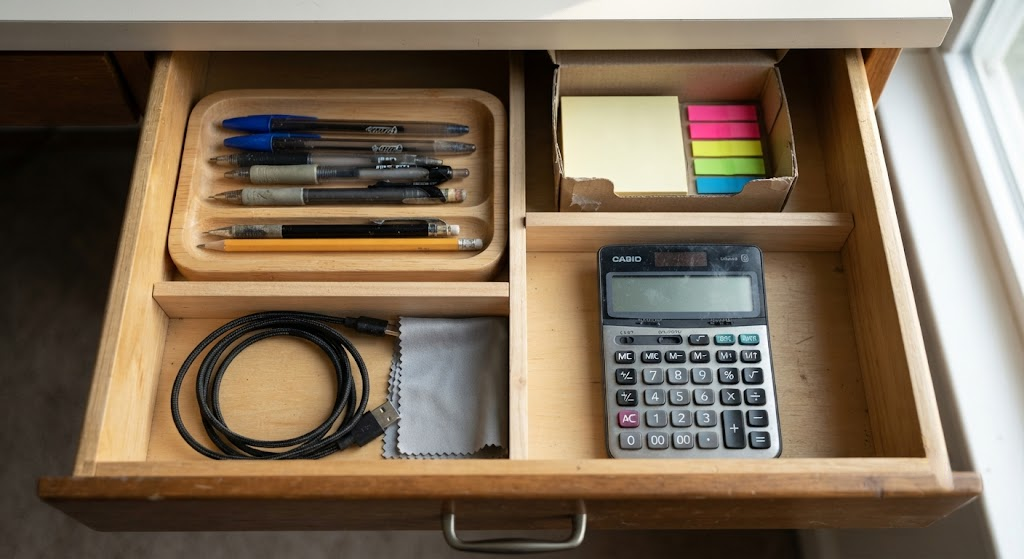

The KonMari Problem
I respect Marie Kondo. But I've also watched three different colleagues fold their office drawers into perfect little vertical rows of notebooks and charger cables, only to have the system collapse within two weeks. The problem isn't the folding technique. It's that most organizing systems are built for a one-time reset, not for the daily reality of reaching into a drawer while you're on a call and grabbing what you need without looking.
In product management, we call this "first-order accessibility" — the principle that the items you touch most frequently should be reachable in under one second with minimal physical effort. It's the same logic that puts the volume knob on a stereo instead of inside a menu. Your drawers should follow the same rule.
The Five-Minute System
Step One: Empty Everything — But Don't Sort Yet
Pull everything out of every drawer in your desk. Pile it on the floor or the desk surface. Don't sort. Don't evaluate. Don't have feelings about individual pens. Just empty. This takes one minute.
The reason to delay sorting is that evaluating items one by one while they're still in the drawer leads to "drawer blindness" — you've seen the same paperclip in the back corner for three years, so your brain skips over it as background noise. Seeing everything in an unfamiliar context — a pile on your desk — forces you to actually look at it.
Step Two: The Frequency Sort — Not Categories
Most organizing advice tells you to group by category: all pens together, all cables together, all sticky notes together. Categories are tidy but they ignore frequency of use. A pen you use ten times a day and a spare Sharpie you use once a month don't belong in the same compartment just because they're both "writing instruments."
Instead, sort everything into three piles:
Daily: Items you touch at least once per workday. Pen, notebook, phone charger, earbuds, the one pair of scissors you actually use.
Weekly: Items you need regularly but not constantly. Stapler, extra sticky notes, label maker, backup USB drive, that one specialty cable.
Archive: Items you keep just in case. Spare keys to a filing cabinet you no longer own, a manual for a monitor from 2017, three sizes of paperclips when you only use one size.
This frequency sort takes two minutes. No agonizing. Trust your gut on what's daily versus weekly — you already know.
Step Three: The Drawer Assignment
Here's the product-manager rule that makes the system stick: the top drawer holds only daily items. The middle drawer holds weekly items. The bottom drawer holds archive and bulk supplies.
Why top drawer for daily? Because the top drawer is the one you can open without bending, twisting, or rolling your chair back. It's a sub-two-second movement from typing position. Every inch of additional reach — reaching to a middle drawer, bending to a bottom drawer — adds friction. Friction compounds. Across a year of eight-hour days, the difference between a top-drawer reach and a bottom-drawer bend is measurable in lost focus and physical strain.
If you only have one drawer — common in smaller desks — partition it into front and back zones. The front 60% holds daily items. The back 40% holds weekly items. Archive items don't belong in a single-drawer desk; they go in a closet, a credenza, or a shelf bin.
The Divider Strategy: Nothing Fancy Required
Avoid the "Everything Needs a Home" Trap
You don't need custom velvet-lined compartments with laser-cut silhouettes for each pen. Those systems are maintenance-heavy — one new item that doesn't match the cutout, and the illusion of order breaks. Instead, use expandable drawer dividers: spring-loaded bars that create adjustable compartments in seconds.
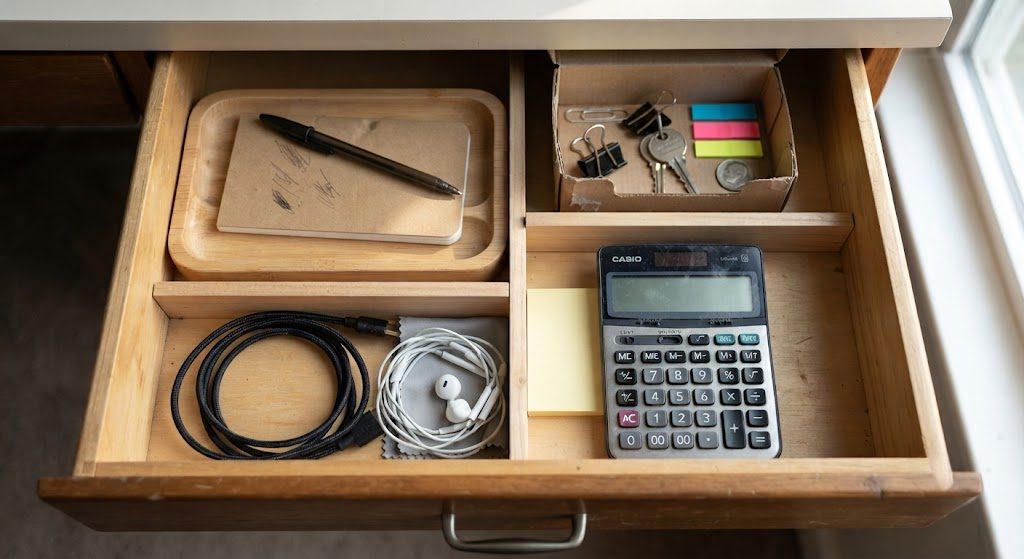
David's dividers cost $12 for a set of four. He configured them into four zones in his top drawer:
A wide zone for a notebook and a small notepad
A narrow zone for pens and pencils
A square zone for charger cables and earbuds
A small catch-all zone for "miscellaneous that will be sorted properly at end of day"
The catch-all zone is intentional. A perfectly organized drawer with no flex space is a drawer that will be messy again by Wednesday. Building in one "deal with this later" section acknowledges how humans actually behave — we put things away imperfectly during busy moments, and we need a designated place for that imperfection that doesn't contaminate the rest of the system.
Small Trays Inside Drawers
For very small items — paperclips, SD cards, SIM tools, the tiny screwdriver that came with your glasses — use a small, shallow tray or a silicone coaster with a lip. It keeps items from rolling to the back of the drawer and creates a defined "zone" that your hand can find by feel. These small containers don't need to match. David uses a ceramic sake cup for paperclips and a repurposed phone case as a cable-tie holder. The system works because the containers are distinct enough to identify by touch.
The Five-Minute Reset Routine
The system only survives if it has a reset mechanism. At the end of every workday — or the end of every week, if you're less disciplined — spend literally five minutes doing this:
Empty the catch-all zone. Put everything back where it actually belongs.
Restock daily items. If you used the last sticky note pad, put a new one in.
Scan the top drawer for anything that drifted in from the weekly or archive pile. Remove it.
That's it. No folding. No color-coding. No photography for social media. Just five minutes of returning the drawer to a state where Monday-morning-you can reach in blind and find exactly what they need.
The goal isn't a beautiful drawer. The goal is a drawer you never have to think about.