
The Storage Decision That Shapes Your Workday
In product-management terms, storage isn't about holding things. It's about retrieval speed, visual load, and maintenance overhead. The open-versus-closed decision is the single most consequential storage choice you'll make for your home office — and most people make it based on aesthetics, not function.
I've specified both for product lines and lived with both in my own offices. Here's what actually happens after the installation photos are taken.
Open Shelving: Total Visibility, Total Accountability
What It Does Well
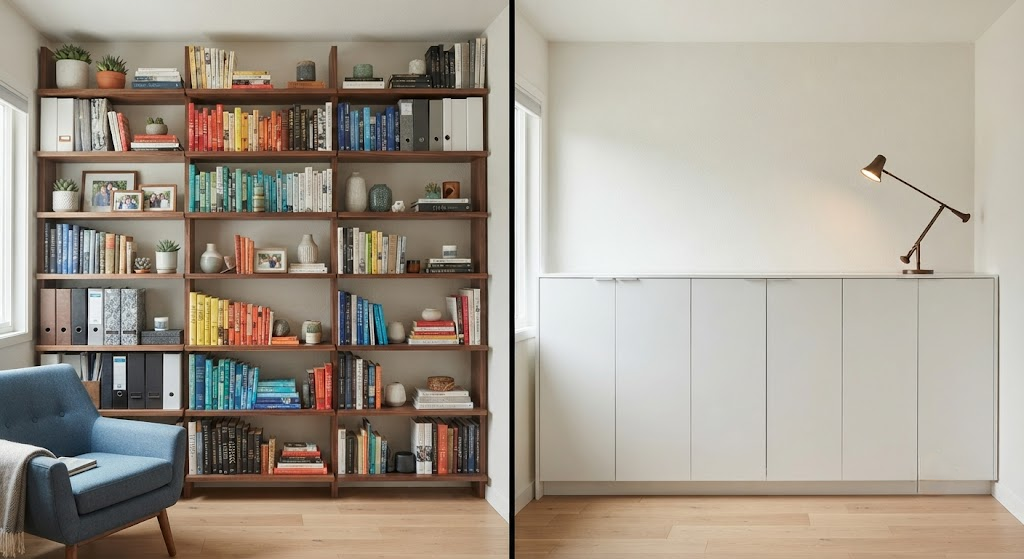
Open shelving eliminates the "out of sight, out of mind" problem. Every book, binder, and box is visible from your chair. Retrieval is instant — no door to open, no hinge to clear, no squatting to reach a low cabinet. For reference materials you touch weekly, this is unbeatable.
It also forces honesty. You can't hide clutter on an open shelf. The system either stays organized or it visibly fails. For people who thrive on external accountability — the shelf as a mirror of your mental state — this is a feature, not a bug.
Where It Fails
Open shelving makes everything in the room compete for your attention. Your eye doesn't distinguish between work materials and visual noise. A row of mismatched spines, a stack of old router boxes, three cables coiled differently — these register as low-grade cognitive load whether you notice them consciously or not.
The maintenance is also real. Open shelves collect dust on every horizontal surface, including the tops of books. In a room with a window, UV exposure fades spine colors within two years. If you have pets, open shelving at low heights becomes a fur trap. I learned this the hard way with a golden retriever.
When to Choose It
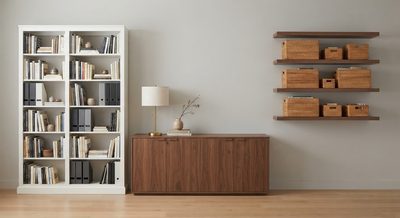
Choose open shelving if you reference physical materials at least weekly, you're disciplined about visual consistency, and you don't mind spending fifteen minutes dusting once a month. The ideal open-shelf setup uses matching bins or boxes for small items — they reduce visual noise while keeping contents accessible.
Closed Cabinets: Hidden, Protected, and Easy to Ignore
What It Does Well
Closed storage removes visual noise from the room instantly. Shut the doors, and the room reads as calm. This matters more than most people realize — your peripheral vision processes the environment continuously, and a visually quiet room supports sustained focus better than a busy one.
Closed cabinets also protect contents. No dust, no UV fading, no curious pets. Paper files stay flat. Electronics don't gather a layer of fine dust on their vents. If you store backup equipment or archives that you access quarterly, closed storage preserves them far better than open shelves.
Where It Fails
The retrieval friction is real. Opening a door is a small motion, but it compounds. I tracked this during my own office reorganization: items stored behind doors were accessed roughly 40% less often than items on open shelves, even when I knew exactly where they were. The extra step — even a fraction of a second — was enough to make me avoid it subconsciously.
Closed storage also enables accumulation. You can't see what's inside, so you forget. A year after closing the doors on a cabinet, most people can't inventory the bottom shelf from memory. This is how backup cables multiply and old manuals from 2017 survive indefinitely.
The cost difference is significant. Closed cabinets require doors, hinges, and hardware — typically 40 to 60 percent more than equivalent open shelving from the same manufacturer.
When to Choose It
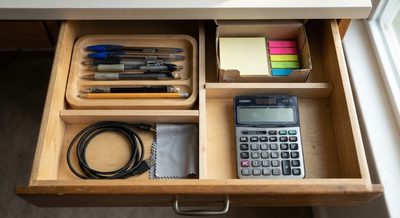
Choose closed cabinets if you store items you access monthly or less, you're sensitive to visual clutter, or your office doubles as a living space where guests will see the storage. The ideal closed-cabinet setup uses labeled bins inside — the door handles the visual calm, and the labels solve the retrieval problem.
The Hybrid Solution
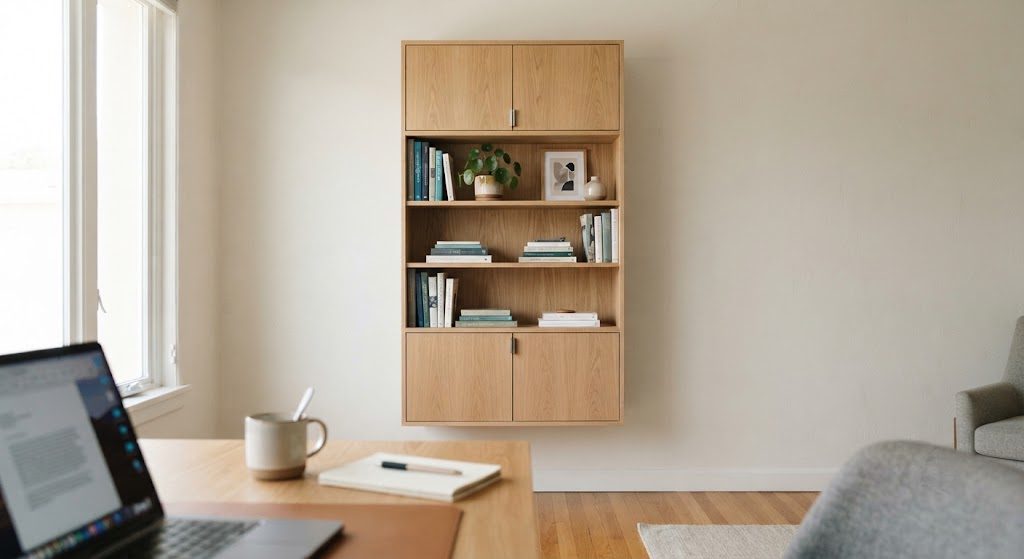
In practice, most functional offices use both. The product-manager rule I developed: place open shelving at eye level and within arm's reach of your seated position. These shelves hold your daily-driver items. Place closed storage above and below — high cabinets for archives, low cabinets for bulky supplies. The open zone handles retrieval speed; the closed zones handle volume and protection.
This hybrid approach is what I spec'd for my last product line, and it's what I use in my own office today. A single 72-inch wall unit with open shelves in the center third and closed cabinets on the top and bottom thirds. The open section holds six reference books, a set of notebooks, and a small plant. The closed sections hold everything else. The room reads as clean, but my daily-use items are visible and reachable without a single door opening.