
The Question No One Asks Before Buying
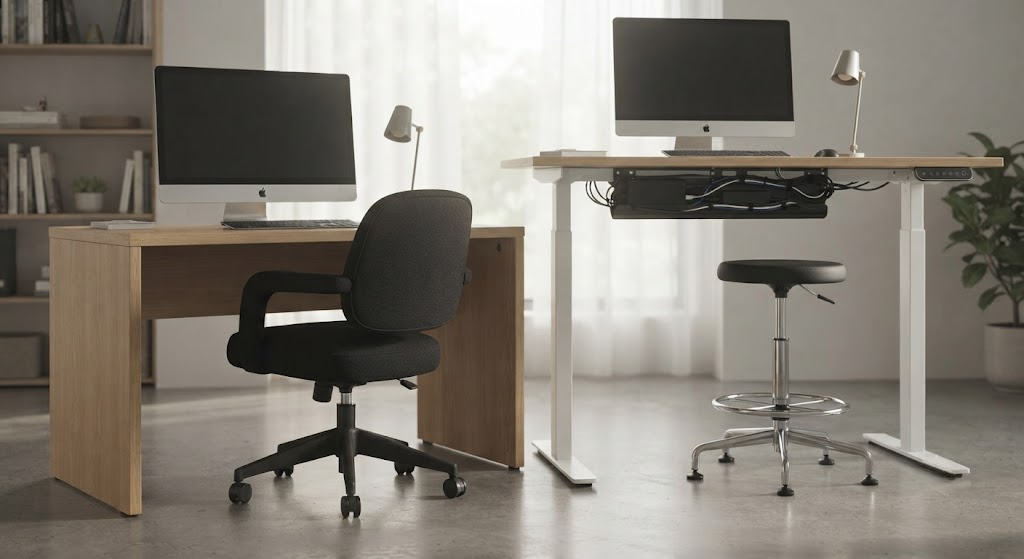
I’ve sat through roughly thirty product-review meetings where the agenda was “standing desk vs. fixed-height.” In every single one, the discussion started with health statistics and ended with a cost-per-feature spreadsheet. Not once did we open with the question that actually matters: What does your workday look like, minute by minute?
Health is a terrible starting point for this decision — not because it’s unimportant, but because the evidence is a moving target. What isn’t a moving target is your workflow: do you vanish into deep-focus coding blocks lasting three hours, or does your day fracture into fifteen-minute sprints between emails, calls, and spreadsheets? Answer that, and the desk recommendation practically writes itself.
The Four-Factor Framework
Forget “just move more.” Use these four criteria to decide.
1. Your Flow State, Measured in Minutes
If you produce your best work in uninterrupted stretches lasting 90 minutes or longer, a fixed-height desk might actually serve you better. Here’s why: standing introduces a low-grade physical awareness — shifting weight, adjusting posture — that can pull you out of deep cognitive work. I learned this the hard way when I switched to a sit-stand frame during a quarter of heavy spec-writing. My output dropped, not because I was tired, but because I kept breaking concentration to lower the desk “just for this next section.”
If your work is reactive — customer support, project management, design sprints — the physical transition of raising and lowering the desk can become a useful ritual. It marks the shift from morning standup to afternoon solo work. For these roles, a standing desk often pays for itself in energy management, not posture correction.
2. The Room You Actually Have, Not the One You Want
An electric standing desk needs a 24-inch clearance zone behind it for the frame to rise without hitting a windowsill, a radiator, or a bookshelf. In a spare bedroom that’s only 10 feet deep, that can be the difference between a working office and a claustrophobic one. I’ve measured dozens of rooms where a fixed-height desk allowed a proper 36-inch walkway behind the chair, but adding a standing frame pushed the chair into the closet door. Don’t trade ergonomic adjustability for circulation space — that’s a losing deal.
Also check your ceiling height. A desk raised to standing position puts your monitor at roughly 56–60 inches off the floor. If you’re tall and your attic office has a sloped ceiling at 72 inches, you’ll be staring at drywall, not the screen.
3. What Your Floor Can Actually Support
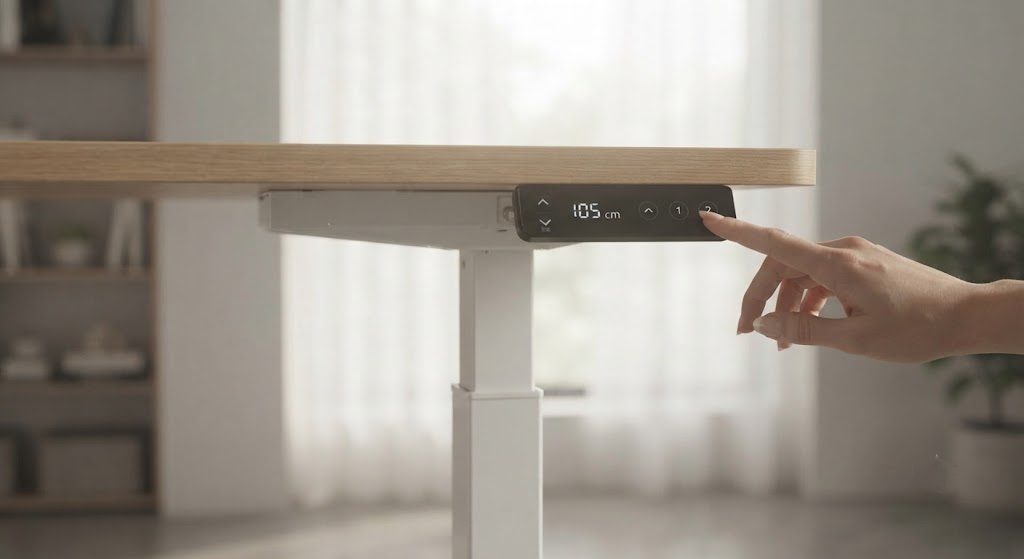
This is the spec-sheet detail that never makes the YouTube reviews. A dual-motor sit-stand frame with a solid wood top can weigh 150 pounds before you add monitors and equipment. That’s fine on concrete or hardwood. On an upper-floor apartment with carpet and a plywood subfloor, it’s still probably fine — but check the floor joist direction and point-load distribution. A standing desk concentrates all that weight on four small feet. Over time, you might see impressions in the carpet pad that never recover. If you’re renting, a fixed-height desk with a wider footprint is the safer bet for your security deposit.
4. How Long You Sit at a Time (Not How Long You Sit All Day)
The metric that actually correlates with discomfort isn’t total sitting hours — it’s the length of your longest uninterrupted sitting session. If you break every 45 minutes to make tea or let the dog out, a good ergonomic chair paired with a fixed-height desk at the correct elbow height can keep you pain-free indefinitely. If you regularly sit for three-hour stretches, the ability to stand for one of those hours matters enormously. Don’t average your sitting time. Look at the peak.
My Personal Recommendation Logic
If your session length averages under 90 minutes, and you’re in a smaller room, get a fixed-height desk with an anti-fatigue mat for standing breaks — you’ll save money and floor space. If your session length tops two hours and your room has clearance, an electric standing desk with programmable presets will change how your body feels at 4 PM. Either way, the decision should be about the shape of your workday, not a wellness trend.