
The Three-Word Problem
In every product-line review I ever ran, the materials conversation was the longest and most contentious. Marketing wanted words like "premium wood." Engineering wanted spec grades and density numbers. Legal wanted disclaimers about moisture and UV exposure. The customer, meanwhile, was left with three vague categories — laminate, veneer, solid wood — and almost no information about what separates the good from the garbage within each one.
Here's what I wish every desk shopper knew: the material hierarchy isn't laminate → veneer → solid wood, cheap to expensive. It's more like three parallel tracks, each with a cheap version and a good version. Your job is to match the material to your abuse profile — what your desk will actually endure, not what looks nicest in photos.
1. Laminate: The Most Misunderstood Surface
The Cheap Version: Melamine
Melamine is a single layer of printed paper saturated with resin and bonded directly to a particle-board or MDF core under low pressure. The decorative layer is paper-thin — literally. If you drag a laptop across it daily, the edge will wear through within 18 months. If water sits in that exposed seam where two panels meet, the particle board underneath will swell and never return to shape. Melamine is the material behind most $150–$300 flat-pack desks, and it performs exactly to that price point.
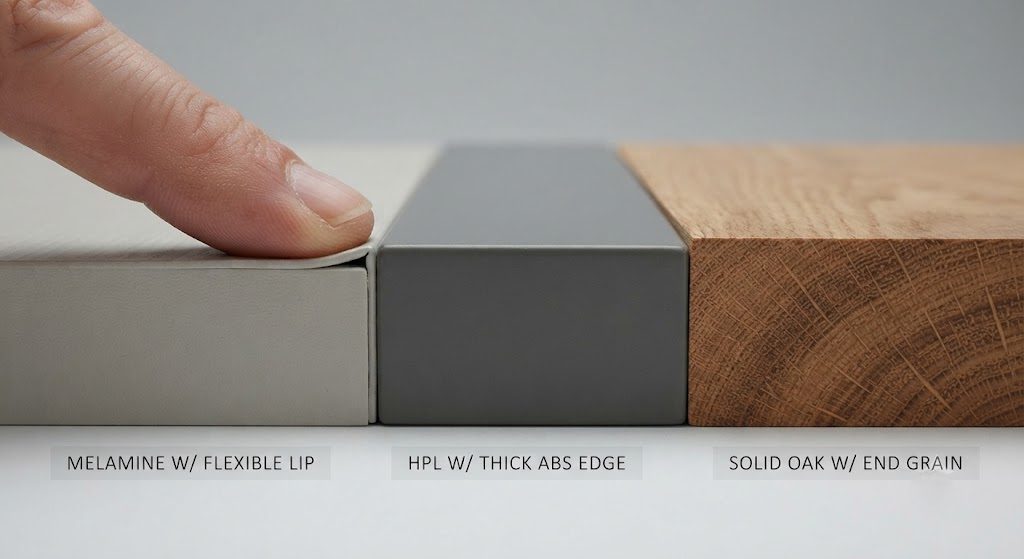
How to spot it: the edge banding. Melamine desktops use a thin, iron-on PVC edge tape that feels slightly raised under your fingernail. Look at the corners — if you see a visible seam line where the edge tape meets, it's melamine.
The Good Version: High-Pressure Laminate (HPL)
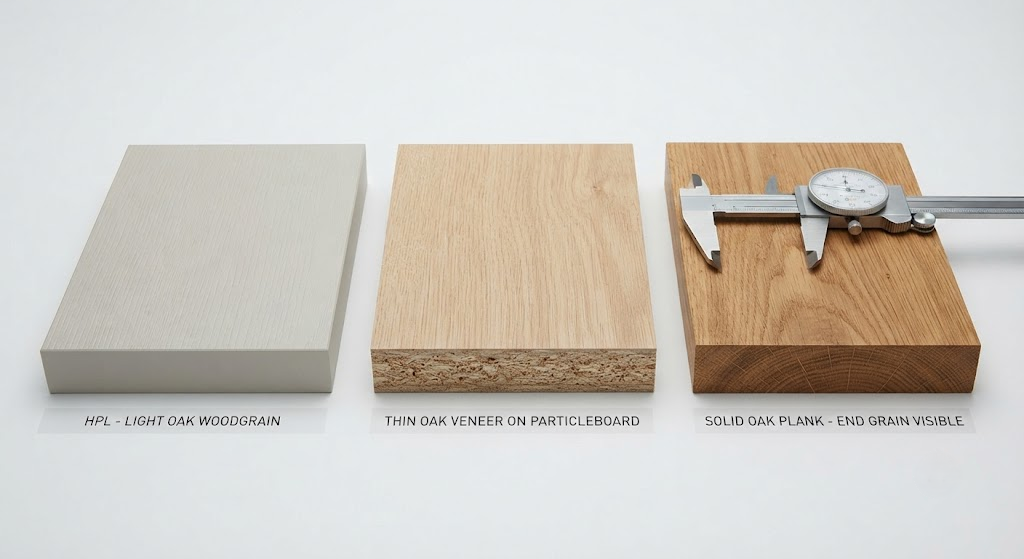
HPL is a completely different material. Multiple layers of kraft paper are saturated with phenolic resin and fused under extreme heat and pressure. The decorative layer is buried under a transparent wear layer that resists scratches, stains, and impact. HPL is what you find on commercial office furniture, laboratory benches, and restaurant tables — surfaces designed for abuse.
HPL shrugs off coffee spills, resists scratches from a ballpoint pen applied with force, and won't delaminate at the edges under normal indoor humidity swings. The cost is higher — expect to add 30–50% over a melamine equivalent — but the lifespan extends from two years to ten or more.
How to spot HPL: the edge will be thicker and won't show a seam line at the corners. Quality manufacturers radius the edge slightly or apply a solid ABS edge band that sits flush. If you can press your fingernail into the edge and feel a distinct lip, it's not HPL.
2. Veneer: The Honest Compromise
What Veneer Actually Is
A veneer desktop is a thin slice of real wood — typically 0.5 to 2 millimeters thick — bonded to a stable substrate, usually MDF or plywood. It is real wood. It ages like real wood. But the thinness changes everything about how it behaves and how you maintain it.
Where Veneer Wins
Veneer gives you the look and warmth of solid wood at roughly half the price, with one significant structural advantage: it doesn't warp. Solid wood expands and contracts across its width with seasonal humidity changes. A veneer surface bonded to MDF is dimensionally stable — the substrate fights the movement. If your home office is in a basement, an attic, or a room without consistent climate control, veneer on a good substrate will stay flatter than solid wood.
Where Veneer Fails
You cannot refinish veneer. The decorative layer is thinner than a credit card. A deep scratch that cuts through the veneer exposes the substrate underneath — usually pale MDF that looks nothing like the surface. There's no sanding it out. Once the veneer is breached, the repair options are colored wax sticks and strategic monitor placement. If you eat lunch at your desk, write with a heavy hand, or have kids who occasionally test surfaces with sharp objects, veneer is a risk.
The spec-sheet check: look for "face veneer thickness" in the product details. Anything below 0.6mm is considered thin and will telegraph substrate imperfections over time. Premium veneer desktops use 1mm to 2mm face veneers that allow a light refinishing — one careful sanding, once — before wearing through.
3. Solid Wood: The Lifetime Surface That Demands Honesty
What You're Actually Buying
Solid wood desktops are typically built from edge-glued strips of a single species — oak, walnut, acacia, rubberwood, maple — milled flat and finished with oil, lacquer, or polyurethane. The material is beautiful, heavy, and repairable. Twenty years from now, if the surface is scratched and stained, you can sand it down to fresh wood and apply a new finish. No laminate or veneer offers that.
The Hidden Cost: Movement and Maintenance
Solid wood moves. Across a 60-inch desk, the width can change by up to a quarter-inch between summer humidity and winter dryness. A solid wood top bolted rigidly to a metal frame will crack if the mounting holes don't have elongated slots to allow movement. I've seen this failure in warranty claims — the desk arrives in July, looks perfect, and by February there's a hairline split radiating from a fixed screw hole. A good solid-wood desk spec will mention "floating attachment" or "expansion slots." If it doesn't, ask.
Solid wood also demands that you treat it like furniture, not a utility surface. Water rings from a cold glass left overnight will mark an oil-finished top. A hot mug placed directly on lacquer can blush the finish white. These aren't defects — they're the material's honest response to its environment. If you're the kind of person who wants a surface you can forget about, solid wood is not your material, no matter how much you like how it looks in photos.
The Quick-Reference Decision Table
Material | Scratch Resistance | Water Resistance | Refinishable | Best For |
|---|---|---|---|---|
Melamine | Low | Low (edges fail first) | No | Budget setups, light use |
HPL | High | High | No | Daily abuse, food, kids |
Veneer (thin) | Medium | Medium (substrate at risk) | No | Climate-controlled, careful use |
Veneer (thick) | Medium-High | Medium | Once, carefully | Looks + moderate durability |
Solid Wood | Medium (refinishable) | Low-Medium | Yes, repeatedly | Lifetime investment, controlled humidi |