

Home Office Desk Setups That Actually Fit Real Rooms
Most people start with a chair or a finish color. I start with tape on the floor. Home office desk setups fail when the desk is too deep for the room, the chair cannot pull back, or the printer ends up across the house. Measure first, then buy furniture that fits the work you do for eight hours a day. That sounds plain, but it is the difference between a room that supports your job and a room that keeps asking for fixes.
Measure the room before you shop
The first rule of home office desk setups is to measure the path behind the chair before you buy anything. For a standard seated desk, 30 to 36 inches of clearance behind the chair is a comfortable target. If the room is small, 24 inches can work, but only if you are not constantly standing up to reach storage. A 10-by-11 room can usually handle a 60-inch-wide desk, a slim file cabinet, and a bookcase. An 8-by-10 room usually does better with a 48-inch desk and wall storage instead of a bulky credenza.
Depth matters just as much as width. A 24-inch-deep top is the safest default because it leaves room for a monitor, keyboard, and writing space without swallowing the floor. If you use two monitors or a laptop on a riser, 30 inches is easier on your eyes and your shoulders. Do not forget the door swing, baseboards, and outlets. I have seen people buy a beautiful desk, then discover the drawer hits the closet door every time it opens. Tape the footprint, sit in the chair, and make the bad surprise happen before the delivery truck shows up.
Choose the build that holds up
A desk should survive coffee, monitors, shipping labels, and the occasional elbow slam. Solid wood looks great, but it is not the only smart buy. A well-built laminate top over MDF or particleboard can last for years if the edge banding is sealed and the frame is rigid. What you want to avoid is a light, hollow top paired with thin legs that wobble when you type. A steel frame with cross supports usually feels steadier than a pretty frame that saves weight at the wrong places.
For sit-stand models, pay attention to the motor rating, not just the marketing. Dual-motor desks are usually smoother under load, especially with dual monitors and a laptop dock. A decent standing desk should feel stable at sitting height and not shake like a folding table when raised. If the warranty is only one year, that is a clue. Five years is common in the better midrange; longer is better when the moving parts are doing the work every day. A cheaper fixed-height desk with a solid top can be the smarter buy if you do not need height adjustment at all.

Storage should earn its footprint
Storage is where a lot of rooms go off the rails. People buy a desk, then a bookshelf, then a rolling cart, and soon the room feels crowded even though nothing is especially large. Start with what you actually use every day. If you work mostly on a laptop, keep the surface clear and put supplies in one drawer pedestal or a small cabinet. If you handle paper, get a real file drawer instead of stacking folders on the desktop. A shallow drawer for chargers, pens, and notebooks saves more time than a pretty tray on top of the desk.
Wall storage is the best deal in a small room because it leaves the floor open. One 36-inch shelf above the monitor can hold books and backup gear, and a second shelf can take a printer or archive boxes. If you share the room with guests, closed storage matters more than open shelving because it hides the work mess between calls. Cable trays, power strips mounted under the top, and a clip for the laptop cord are not glamorous, but they keep the desk from turning into a knot by Friday afternoon.
Layouts that work in corners, closets, and shared rooms
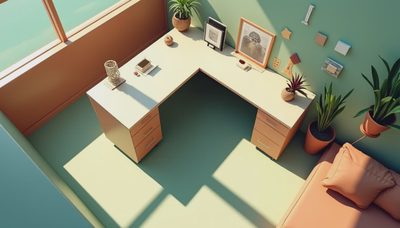
The best home office desk setups are the ones that respect the room you actually have. In a corner office, an L-shaped layout can work if one leg is shallow and the other carries the monitor and keyboard. That gives you one zone for computer work and one zone for paperwork without asking for a giant footprint. In a closet office, a 42- to 48-inch desk with a wall shelf above it often beats a full cabinet because it keeps the space from feeling boxed in.
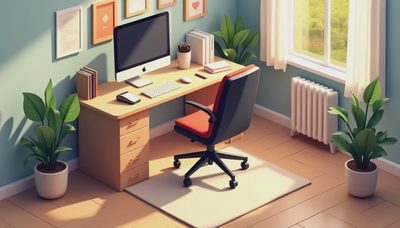
In a shared bedroom or living room, place the desk so your chair does not block a walkway. If you can, put the monitor perpendicular to the window instead of directly in front of it. That cuts glare and keeps the screen readable during the day. A 27-inch monitor arm is worth the money if desk depth is tight because it frees up surface space and gets the screen off the tabletop. For video calls, one simple lamp at face level usually does more for the room than a stack of decorative lights that look good and work poorly.

Spend where the wear shows up
If you are deciding where to put the money, start with the parts that get touched every day: the top, the frame, the drawers, and the warranty. You can save on the chair if you already own a decent one, but do not cheap out on a desk that flexes or a storage piece with weak slides. Soft-close drawer glides feel minor in a showroom and major on a Tuesday morning. Metal drawer runners generally outlast the light-duty plastic hardware that shows up on the lowest-priced pieces.
Budget also matters by use case. A simple fixed-height desk in the $250 to $450 range can be enough for a laptop, one monitor, and light paperwork. A stronger desk with better storage usually lands in the $500 to $900 band. Sit-stand desks with better motors and cleaner cable routing tend to start above that. If you are comparing brands, the big difference is usually not magic design; it is frame thickness, hardware quality, and how much weight the product can carry without shaking. When you shop that way, you stop paying for pretty pictures and start paying for work that holds together.
When you build home office desk setups this way, the room gets easier to use every day. The desk fits, the cords stay out of sight, and the storage does the boring jobs quietly. That is the whole game: a workspace that does not need constant rescue.